
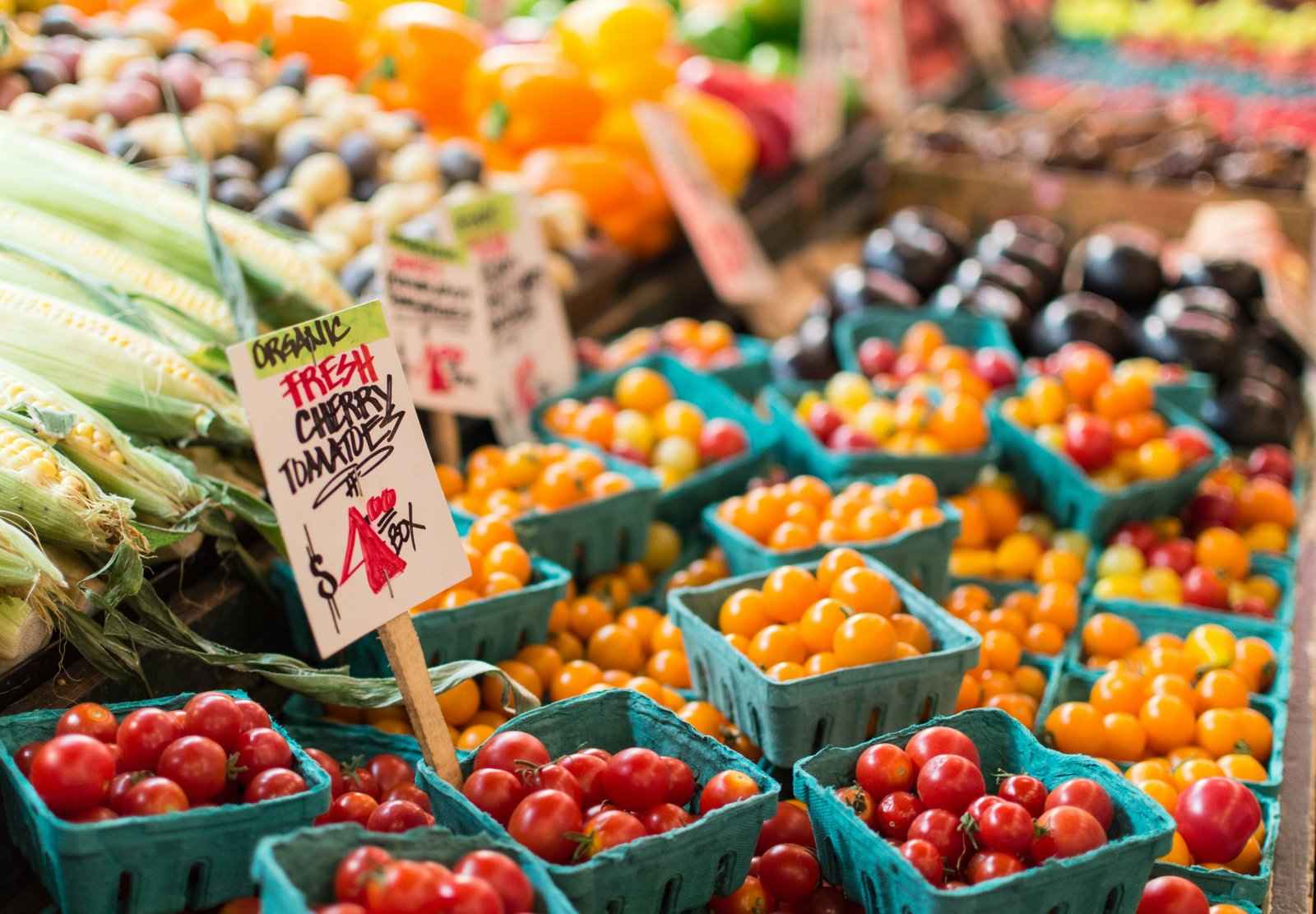
Walk into any major grocery store and the produce section looks flawless. The apples shine like polished mirrors, the strawberries are calibrated to the exact same diameter, and fresh blueberries sit in plastic pints in the middle of winter. It looks convenient, but that picture-perfect display comes with steep hidden trade-offs. Most supermarket fruits and vegetables are bred to survive thousands of miles of rough shipping in refrigerated trailers, not to deliver peak flavor or maximum nutrition.
Choosing local farms completely changes your connection to food. Understanding why regional agriculture matters for your household, your wallet, and your soil—paired with a straightforward checklist to identify genuine farm goods from commodity warehouse stock—is one of the most effective steps you can take for mindful living.
Why Supermarket Produce Isn't What It Used to Be
To understand why local food is worth seeking out, look at how the typical industrial distribution pipeline operates:
- It travels thousands of miles: In the United States, grocery store produce travels an estimated 1,500 miles on average from farm to plate. Keeping food stable across cross-country freight lines takes extensive refrigerated transit, plastic clamshells, and heavy fuel consumption.
- It is bred for durability, not flavor: Large-scale commercial farms prioritize cultivars with tough skins, rigid cell walls, and slow-decay profiles so produce does not bruise when processed by mechanical grading equipment. Rich taste and micronutrient density become secondary concerns.
- It is picked before reaching true ripeness: Most commercial tree fruit and vine crops are picked rock-hard and green so they do not rot on the road. Once they reach regional warehouses, suppliers pump ethylene gas into storage chambers to turn the skin the right color. The produce looks ripe on the surface, but it never developed its full natural sugars and minerals on the living vine.
What Actually Happens When You Buy From a Local Farm
Redirecting your food budget to growers in your region delivers immediate, measurable benefits:
1. You Get Peak Flavor and Real Nutrition
Fruits and vegetables synthesize vitamins and natural sugars while receiving nutrients directly from the living soil and parent plant under natural sunlight. Once harvested, water-soluble vitamins (especially Vitamin C and B-complex vitamins) begin to break down rapidly. A tomato picked yesterday morning from a farm ten miles down the road is packed with aromatic compounds and active nutrients. A grocery store tomato picked weeks ago in another country has surrendered a substantial portion of its nutritional value.
2. Your Money Stays in Your Neighborhood
When you spend $100 at a national corporate grocery chain, only about $14 stays inside your immediate local economy; the rest is channeled to corporate headquarters, distant logistics brokers, and out-of-state distributors. In contrast, when you spend $100 directly with a local grower, roughly $50 to $70 stays directly in your community. Independent growers recirculate those dollars by paying local wages, buying inputs from regional hardware and feed shops, and paying taxes that maintain municipal infrastructure.
3. You Protect Farmland and Diverse Crop Varieties
Industrial agriculture relies heavily on vast monocultures—planting thousands of contiguous acres with a single crop variety. This pattern wears down the topsoil and makes fields vulnerable to pest infestations. Small family farms are far more likely to rotate fields, incorporate natural compost, and preserve flavorful, rare heirloom cultivars that cannot survive commercial container transit.
Quick Guide: Local Produce vs. Commercial Produce
Use this side-by-side comparison next time you are stocking your kitchen:
| Attribute | Commercial Grocery Produce | Real Local Farm Produce |
|---|---|---|
| Shape & Size | Every unit is identical, calibrated, and mechanically sorted | Natural variations: irregular shapes, mixed sizes, minor healed field marks |
| Skin Coating | Thick petroleum or carnauba wax coating applied for shine and moisture sealing | Natural skin, frequently displaying an intact powdery white protective bloom |
| Stems & Foliage | Stems brittle and dried out, or sheared flush; tops cleanly removed | Fresh, supple green stems; root vegetables with vibrant leafy tops intact |
| Aroma | Very faint or absent due to early harvest and cold-storage dormancy | Strong, rich aroma noticeable before you even cut into the item |
| Seasonal Rhythm | Available 365 days a year, completely separated from local climate cycles | Only available during your region's natural seasonal harvest windows |
| Labeling & Pack | Small 4-digit barcode stickers on each unit; branded plastic packaging | Sold loose, in brown paper sacks, or in simple wooden pint baskets |
How to Spot the Difference with Your Own Eyes
You do not need an agronomy background to tell authentic farm produce from warehouse surplus. Look for these reliable physical cues:
1. The Powdery "Bloom"
Check the exterior of fresh blueberries, plums, dark grapes, or cucumbers. If you notice a soft, hazy, whitish dusting across the skin that rubs away easily with your finger, you are looking at natural "epicuticular wax," or bloom. The plant produces this organic barrier to safeguard fruit against moisture loss and insects. Industrial dump tanks, mechanical brush washers, and commercial wax applicators wash this delicate layer off. An intact powdery bloom is direct proof of gentle handling and recent field harvest.
2. The Leafy Tops
Conventional supermarket root crops like radishes, beets, and carrots almost always arrive with their foliage cut off. Because green leaves pull moisture out of the root flesh during long highway journeys, distributors chop them off to prevent the roots from becoming rubbery. Local growers bring crops to market within hours of harvest, allowing them to keep crisp, edible greens attached.
3. The Aroma Test
Pick up a commercial strawberry or peach at a chain store and smell it. Most often, you will detect very little scent. This happens when fruit is harvested before natural sugars develop and held in near-freezing distribution facilities. In contrast, tree-ripened local fruit exudes a powerful, recognizable aroma the moment you hold it.
Beware of "Market Resellers" (How to Spot a Fake Farm Stand)
A common pitfall at suburban farmers' markets is the produce jobber. Some vendors purchase discounted excess cartons from commercial food distribution hubs, discard the cardboard packaging, arrange the goods in rustic bushel baskets, and sell them at local prices.
Three Checks to Protect Your Purchase:
- Look for Sticker Residue: Check peppers, citrus, and stone fruit for small four-digit PLU stickers (or the sticky adhesive outline where one was pulled off). A PLU sticker indicates commercial wholesale routing.
- Verify What Is in Season: If a vendor at an outdoor market offers sweet corn or vine-ripened field tomatoes in April, those crops did not come from local dirt.
- Talk to the Grower: Ask direct, practical questions about the crop: "What variety of potato is this?" or "How did the heavy rain last Tuesday affect your harvest?" A real grower answers immediately with specific field details. A reseller will stay vague.
— Prince Wallace
The Authority Section: Agricultural Systems & Food Literacy
Developing an informed perspective on food sovereignty requires understanding the systemic distinctions between conventional logistics and regenerative regional food sheds. When evaluating food labels, seasonal availability, and agricultural claims, reference the foundational definitions and regulatory distinctions outlined below.
Comprehensive Agricultural Glossary
Agroecology: An ecological discipline that treats farmland as an integrated, living ecosystem. Agroecological production relies on natural nutrient cycles, beneficial insect habitats, and soil microbiome preservation, substantially eliminating the requirement for synthetic petro-chemical inputs.
Community Supported Agriculture (CSA): A direct-to-consumer economic structure in which local households purchase a defined "share" of a designated farm's harvest prior to spring planting. This model provides the grower with working capital to purchase seed, maintain machinery, and hire field labor without acquiring commercial debt, while offering members fresh seasonal produce each week.
Food Miles: The cumulative geographic distance food travels from the initial harvest acreage through industrial aggregation centers, packaging facilities, and cold storage warehouses before reaching the consumer's shopping cart. Elevated food miles represent extended transit timelines, intensive fuel expenditures, and heightened cold-chain energy demands.
Heirloom Cultivar: An open-pollinated plant lineage preserved and handed down across family lineages or gardening networks for fifty years or more. Unlike commercial hybrid seeds (F1 hybrids) designed for machine uniformity, heirloom varieties preserve biological heritage and are selected for complex flavor profiles, diverse colorations, and regional adaptability.
Cover Cropping: The practice of seeding non-cash vegetation—including hairy vetch, rye, and crimson clover—during seasonal fallow periods. Cover crops shield exposed dirt from water erosion, draw atmospheric nitrogen into the root layer, break pest life cycles, and enrich organic structure without synthetic chemical fertilizers.
Integrated Pest Management (IPM): A holistic management program that controls pest populations through biological remedies, companion planting, mechanical barriers, and predator insect releases, utilizing narrow-spectrum chemical treatments only as a strictly verified final option.
Soil Organic Matter (SOM): The decomposed biological fraction of soil consisting of plant debris, animal tissues, and active underground microbial networks. High SOM content drastically improves water retention, reduces drought vulnerability, and stores carbon deep within the root zone.
Producer-Only Market: A certified farmers' market operated under explicit administrative bylaws requiring vendors to produce 100% of their inventory on their owned or leased land. Reselling commercial commodity lots is strictly barred, assuring shoppers that their spending directly supports working regional acreage.
Detailed Labeling Standards & Legal Backing
Deciphering food packaging requires distinguishing between legally binding regulatory certifications and non-enforceable marketing terms:
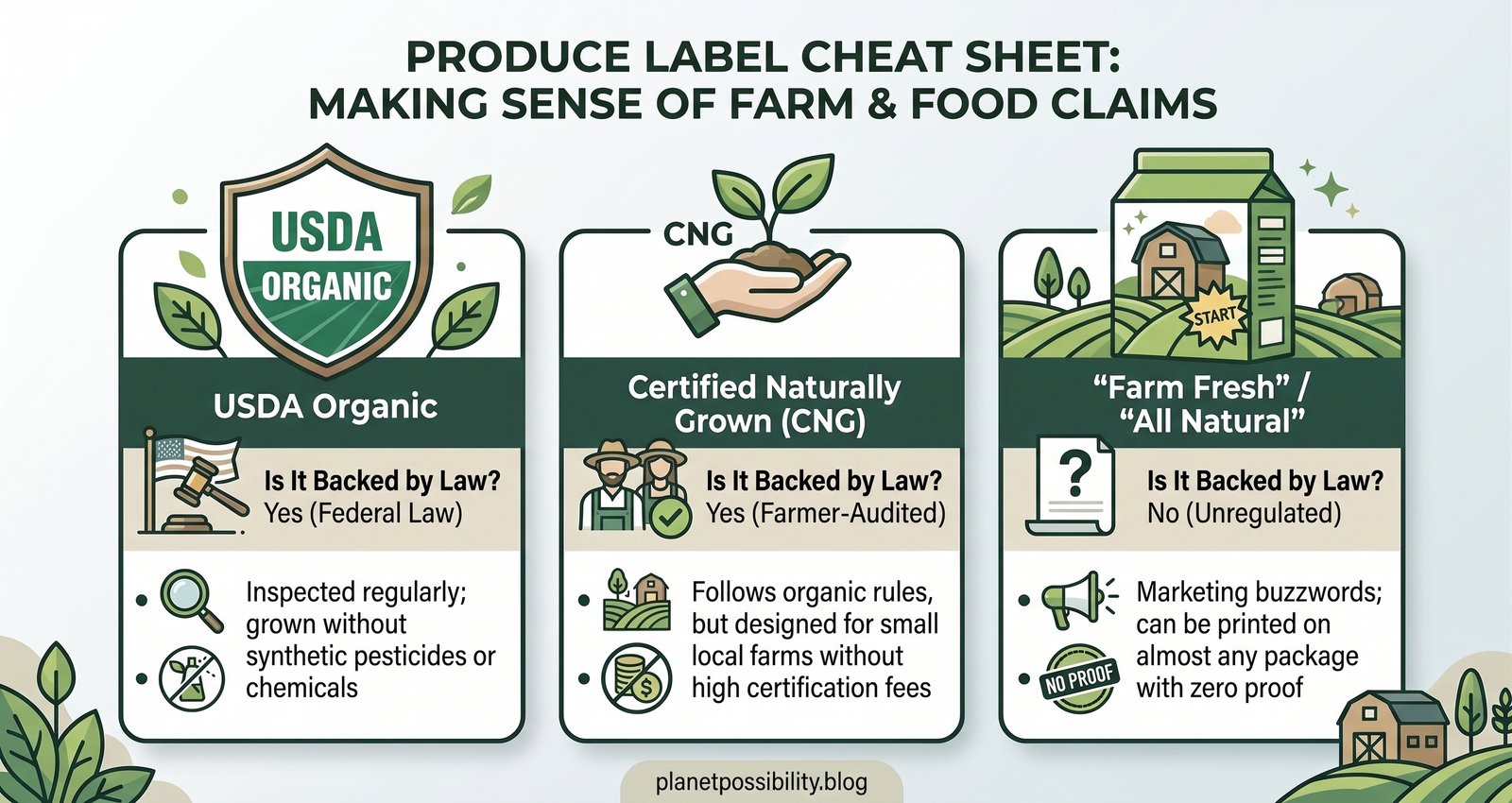
- USDA Organic: Regulated under Title 7, Part 205 of the Code of Federal Regulations. Prohibits synthetic nitrogen fertilizers, sewage sludge, synthetic pesticides, genetic modification (GMOs), and ionizing radiation. Operations must submit thorough soil management plans, retain exhaustive audit records, and pass annual third-party inspections. Note: Some dedicated small family growers utilize fully organic growing protocols but decline official USDA certification due to high annual compliance fees and extensive administrative overhead.
- Certified Naturally Grown (CNG): A decentralized, non-profit certification framework explicitly configured for direct-market farms and urban agriculture. CNG mandates identical soil and input standards to the USDA Organic framework, but verification relies on peer reviews conducted by neighboring farmers and regional agricultural extension specialists. This peer-review framework lowers certification overhead while retaining rigorous ecological accountability.
- Unregulated Phrases ("Farm Fresh," "All Natural," "Pure"): Commercial marketing slogans that carry zero statutory meaning under federal labeling mandates. Any distributor or corporate packaging operation can affix these titles to conventionally produced goods without independent auditing, verification, or farming standards.
Verified Academic References
- Li, M., Jia, N., Lenzen, M., et al. (2022). Global food-miles impart significant food-track emissions. Nature Food, 3(6), 445–453. https://doi.org/10.1038/s43016-022-00531-w
- Food and Agriculture Organization of the United Nations (FAO). (2019). The State of the World's Biodiversity for Food and Agriculture. J. Bélanger & D. Pilling (eds.). FAO Commission on Genetic Resources for Food and Agriculture Assessments. Rome. https://www.fao.org/cgrfa/topics/biodiversity/en/
- Low, S. A., Adalja, A., Beaulieu, E., Key, N., Martinez, S., Melton, A., Perez, A., Ralston, K., Stewart, H., Suttles, S., Vogel, S., & Jablonski, B. B. R. (2015). Trends in U.S. Local and Regional Food Systems: A Report to Congress (Administrative Publication No. AP-068). U.S. Department of Agriculture, Economic Research Service.
- Rickman, J. C., Barrett, D. M., & Bruhn, C. M. (2007). Nutritional comparison of fresh, frozen, and canned fruits and vegetables: Part 1. Vitamins C and B and phenolic compounds. Journal of the Science of Food and Agriculture, 87(6), 930–944. https://doi.org/10.1002/jsfa.2825